



By Andrea Bruner, White River Now
For what might be the first time, the 16th Judicial District has a contested race in all four divisions on the March 3 ballot.
The Independence County Bar Association hosted a judicial forum Thursday night at the University of Arkansas Community College at Batesville and invited all nine candidates to participate.
“To the best of our knowledge, there has never been four contested circuit judge races in the 16th Judicial District prior to this election,” said Barrett Moore, president of the local bar association.
Two of the candidates – Holly Meyer in Division 1 and Lee Harrod in Division 3 – are incumbents. Don McSpadden and Tim Weaver currently serve in Division 2 and 4, respectively, but have chosen not to seek re-election.
Moderator for the night was Ben Pollitzer, an attorney with the Department of Human Services and an adjunct professor teaching criminal justice at UACCB; he also serves as the vice president of the Independence County Bar Association.
Pollitzer said circuit courts are “Arkansas’ primary trial courts” and noted that these are non-partisan elections. Circuit judges serve six-year terms.
The 16th Judicial District includes Cleburne, Independence, Stone, Izard, and Fulton counties, and there are four divisions. Candidates are, in alphabetical order:
· Division 1 (civil and probate matters) – Circuit Judge Holly Meyer and District Judge Chaney Taylor;
· Division 2 (family court) – Kara Byars, Scott Davidson and Thomas Kendrick;
· Division 3 (juvenile) – Mathew Gray Dellinger and Circuit Judge Lee Harrod;
· Division 4 (felony/criminal) – Kimberly Edington and Maureen Harrod.
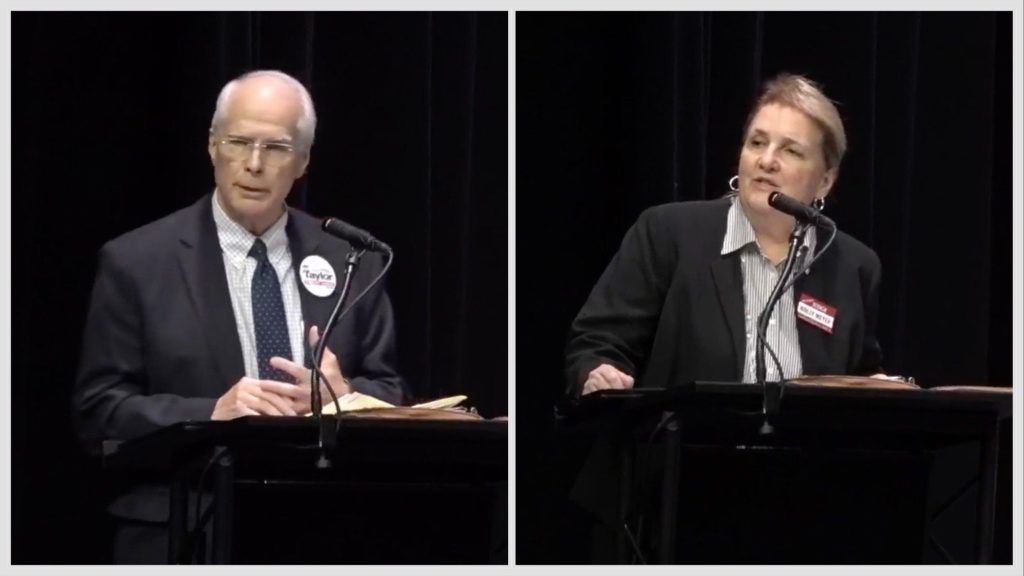
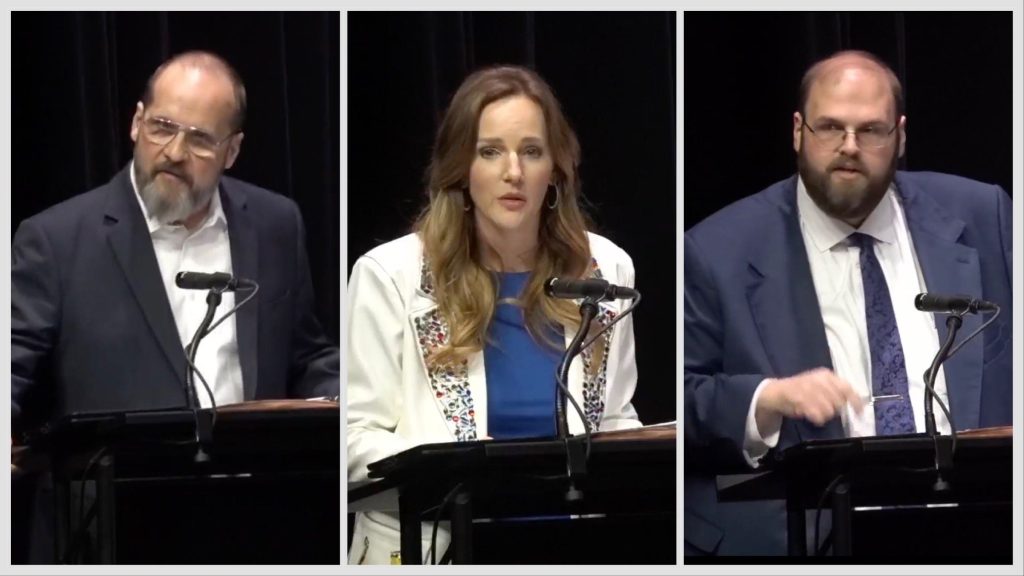
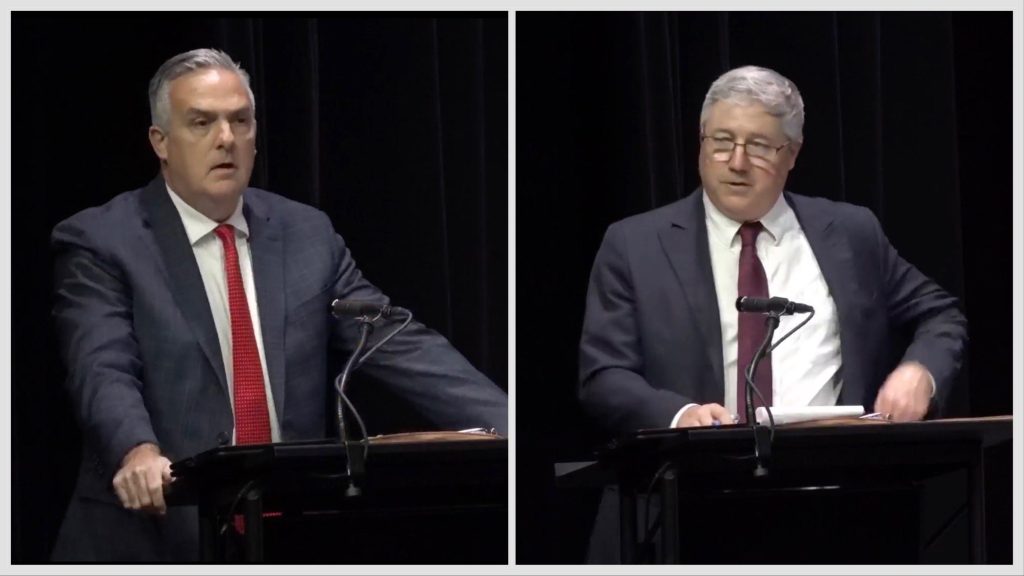

Candidates were given 90 seconds to introduce themselves before getting into the forum.
—
Pollitzer posed the first question to Division 3 candidates, asking what measures they have found effective in maintaining civility during emotionally charged debates in court cases.
Dellinger said he advises clients before court that this will be emotional, but be courteous to opposing counsel and the judge, and to listen to him.
Harrod said as a judge, he has found it best to make expectations clear and what is (and is not) tolerated, to treat everyone fairly, and to let everyone’s voices be heard, but ultimately it is the judge’s job to make sure there is order in the court.
Next, Pollitzer asked the Division 4 candidates what life experiences they bring to judicial office.
Harrod said for 25 years she has had a civil practice in the district, she has served as a prosecutor, trying hundreds if not thousands of felony and misdemeanor cases, and she previously served as a circuit judge in 2017 and 2018, and every experience has made her a better lawyer, not to mention being a mother of four and balancing both work and home.
Edington said her own family had to go through court when she was young, so she decided in elementary school to become a lawyer to help others the way her family had not been helped. A decade ago, she helped start the mental health court and veterans court in Craighead County. She said she has seen both sides of the coin, starting out as a public defender and then serving as a deputy prosecutor, and that “fixing” the problems of the community starts with treatment.
Pollitzer asked Division 2 candidates why they are running for circuit judge.
Davidson asks himself that daily, but it’s something he’s considered over the years and decided this is the “right time” as the position he wanted to run for was open, with the current judge, Don McSpadden, retiring. He said being a husband, father and grandfather gives him experiences he carries over to his work. “Being a judge is not just about knowing the law; it’s about bringing in all your experiences in life. After a lot of prayer and consideration with my wife, I felt like it was the right time. I’ve never run for anything in my life, and I won’t again, but I felt like this was the day,” Davidson said.
Byars said she believes she is the most qualified candidate, as family law has been the focus of her practice for 15 years. Division 2 has about 400 open cases, ranging from domestic relations to guardianship, and only about 25 participants in the drug court. “While I believe drug court is important, clearly the vast majority of the work is family law. I’ve spent years trying those cases – every week I’m in multiple courtrooms, trying different domestic relations matters,” she said.
Kendrick said he has primarily served as a public defender and is running because “over the years I have seen the same people coming back and forth through our justice system,” adding the main reason for that is drug addiction. He has worked with drug court since 2013 and said numbers are down; in fact, the court has had no new participants from Independence County. But he sees a need for the program that diverts nonviolent offenders into treatment and monitoring programs, and he would like to rebuild that.
Pollitzer then turned his attention to the Division 1 candidates and the number of civil and criminal cases they’ve presided over and tried.
Taylor said he has been a district judge for 20 years and presided over thousands of cases; as a young lawyer, he said he sat second chair (under the lead attorney) on several jury trials, but just trying a lot of jury trials does not make one a good judge. He said his heart is in “specialty” or “problem-solving” courts like drug court or DWI court, which he started and was the first of its kind in Arkansas. “I have come to look at the program as a ministry. We get people’s lives turned around,” he said.
Meyer said she has served as a circuit judge for 10 years, presiding over jury trials. Last year, there were 1,941 cases in circuit court, and she’s presided over about 20,000 cases in the last 10 years. She also served as a prosecuting attorney for two years and deputy PA for 25 years, trying murders, rapes, aggravated robberies and other serious felony offenses, advocating for victims. She said comparing district court and circuit court is like “apples and oranges” – or misdemeanors and felonies.
—
Pollitzer then led the second round of questions, starting with District 2 regarding the importance of independence of the judiciary.
Byars said everyone deserves a fair trial, no matter their beliefs, and while judges are guided by their own moral compass, they still have to uphold the constitution and obey the law.
Davidson said in this day and age, government is constantly being questioned and scrutinized, and if the judiciary is not independent, the system fails. “If people do not believe they can come in to court and be treated fairly, be treated courteously, and above all else, there be justice based upon the facts as the law is applied to them, it’s going to be like folks I have run into while campaigning, ‘You’re just going to be another politician’ – it can’t be that way. … We have to be impartial.”
Kendrick agreed with Byars and Davidson, saying judges should not be beholden to political interests or parties. He went on to say even candidates for judge should follow those guidelines, noting his campaign is run by volunteers and while he has no problem with a campaign consultant, there are multiple candidates in this district using the same campaign consultant from Little Rock, bearing the question, “Are those candidates independent of each other?” He said judges are ethically bound not to endorse or oppose candidates for public office, even in judicial races.
Pollitzer then asked Division 3 candidates what factored into their decisions to enter the legal field.
Harrod said his father was a pilot in the Air Force who decided at the end of that career to go to law school. As Harrod spent time at his dad’s law firm, he was always intrigued by the work his father did and how he helped people with problems, and that is what influenced his decision to also be a lawyer.
Dellinger said he wanted to help people, but the biggest factor was his father, as well. He said he saw the respect and admiration his respect brought, and he wanted the same respect and admiration.
Division 1 candidates were questioned about the hardest part of being in the legal field.
Meyer said the hardest part of being a lawyer is all the “lawyer jokes,” but she gets that there can be a lack of respect among lawyers to one another. “How do you make an honorable career of being a lawyer? Well, you do it by helping people, of course. You do it by listening to people, of course. You do it by operating with integrity,” she said, noting that people may say they operate with integrity, but they don’t. Judges are to hear both sides and not be beholden to one side before making decisions. She said she found it ironic to stand before the voters and plead her case, and she finds “a rich justice” in running for office.
Taylor said he finds the hardest part of being in the legal field is dealing with mental health. “Arkansas is somewhat lacking resources that we allocate to those folks,” he said. “We do everything we can to get those folks placed where they need to be, get them on their medications, get them to their doctors … back on track, taking care of themselves and they’re not a nuisance or bothering other folks. I think that’s the biggest challenge we face.”
Division 4 candidates were asked to describe a challenge they have faced in their legal career and how they were able to overcome it.
Edington said her biggest hurdle was getting started, as she came from a poor family and had to work to support herself and her child as she attended law school. She said starting her own law practice was difficult as well, but she did have community support, and she feels blessed.
Harrod said her biggest challenge in this campaign, particularly, is trying to run for office while balancing her workload as well as her family life – not to mention her husband is also balancing his workload and family while running for office, as well. “I know that’s the elephant in the room, and I’d like to hit it straight on. It’s extremely difficult,” she said. She also said that while she enjoys standing up for people and fighting for what’s right, she does not necessarily enjoy standing up to talk about herself, so that too has been an obstacle for her. “It’s been a challenge to hear some of the untruths that have gone on in this campaign, and it’s been a challenge to hear some of the half-truths … and to take the high road and act with integrity.” She said she has worked hard in her career, and she has loved being a lawyer, and she overcomes challenges by working hard.
—
Moving in the third round of questions, Pollitzer turned to Division 2 candidates, asking them to describe their time as an attorney.
Kendrick said he’s worked his entire career as a public defender, and he does not get to turn them down. He’s tried a lot of jury trials and bench trials, and he works in the drug court program, which is different than other cases. Drug court is a judicially supervised probation program and that takes a different skillset than other types of cases, and he said he is the only candidate in Division 2 with that skillset.
Byars said she is the Fulton County attorney and the attorney for the city of Salem, and she is the attorney ad litem representing children in foster care, but she has always been in private practice. She also said she is “the only candidate in Division 2 that has successfully operated a private practice without issue.” She said she’s tried jury trials, civil trials, and domestic cases, and she’s also served as a defender in criminal cases.
Davidson said he’s practiced law in Batesville for 37 years and tried to help the thousands of people that have come through his doors. “I’ve gone to court with them, I’ve sat and listened to them, I’ve cried with them; I’ve been a part of their life,” he said. “I believe I’m the right person to be circuit judge. I have the temperament, the kindness, the heart to serve in that position.” He said he has made mistakes, but he will represent the district with honor and integrity.
Division 1 candidates were asked to describe one or two of the most important cases they have litigated as an attorney.
Taylor said before he became a judge, he had handled divorces, criminal cases, probate and others, but one that stands out was a woman about to lose her house. The woman was scared, and Taylor said the judge ruled against him “every step of the way,” but they appealed and finally “got the correct ruling”: the woman was able to keep and stay in her house. “Even though it seems like a minor case, it was very important to her,” he said. He said the happy cases, and the most satisfying, are the adoptions, which he did when he filled in as a circuit court judge. He finds being a district court judge like a ministry, as so many people come in and their lives are “a trainwreck.” Getting those lives turned around has brought a lot of thankful parents, grandparents and others.
Meyer said she’s had a lot of high-profile cases, such as then-President Joe Biden’s son, Hunter Biden, as well as former Arkansas Secretary of State Bill McCuen. “The most important case I’ve ever done is your case. … Because there is nothing more important to you in the whole world when you get there, that you be treated fairly, that you get to have your word in court, that someone understands what your perspective is in court, and someone applies the facts and the law to you, without bias and partiality. … Every single case is the most important case.”
Division 4 candidates were asked what public office they have held, and if none, what is their most significant form of public service.
Harrod said she has worked in this district since 2000. She was elected to the Heber Springs City Council and was elected/served as city attorney in Heber Springs and in Quitman. She has been a deputy prosecutor in Pulaski and Perry counties as well as the 16th Judicial District. She was appointed by then-Gov. Asa Hutchinson as circuit judge to serve in 2017-18 to fill a vacancy in this district. She was also appointed as a special county judge in Independence and Searcy counties and was also appointed a special Arkansas Supreme Court justice on a couple of different cases. “I have had a career of public service. I have always wanted to give back to my community. Being a part of making our communities better is not just a part of what I do but a part of who I am.” She also speaks at the schools about being a lawyer and served as president of the Booster Club before having to resign before she could run for this office.
Edington said she is not a politician and has not held any public office, but she has served on a number of boards, like the Family Violence Prevention board, Arisa Health board and Legal Aid of Arkansas. She said she works with FVP and her role extends “past just sitting on a board.” She said she answers legal questions that come to her anonymously from those in the shelters free of charge and assists in fundraising as well as contributes directly to the shelters.
For Division 3, candidates were asked about goals as circuit judge, if they are elected.
Dellinger said his goal was to be efficient and push cases through, and to talk to the Department of Human Services and school administrators to gather information to make decisions.
Harrod said juvenile court is constantly changing and he has to adapt as well, but he would to stive to continue what he has done the past 17 years: work with families, be patient, but hold those people accountable when they don’t hold up their end of the bargain, and work to break generational cycles of abuse, neglect, poverty, drug abuse and incarceration. He said he recently told a 12-year-old in Stone County that if he did not go to school, he could face community service or even jail, and the child said both of his parents were in jail and his grandmother was currently in jail. Two weeks later, Harrod said he had a similar situation in Izard County, so there is a lot of work to be done in this district. “Juvenile court is the most important court in this district,” said, noting how important it is to change “the trajectory of children’s lives.”
—
Pollitzer announced they would hear closing statements from the candidates, then allow them to speak with audience members after the forum.
Meyer said the use of AI (artificial intelligence) in pleadings has “exploded” in the last six months. Where a person might represent him or herself previously and presented a handwritten complaint outlining the complaint, “they’ll run it through AI, they’ll come out with a 30-count complaint complete with civil rights declaratory judgments, defamations – I see some clerks out there nodding their heads, yep, we’ve seen that. As a judge, you have handle every single one of those,” so there will be a lot of challenges ahead. As far as drug court, Independence County has three participants at the moment, according to the prosecutor’s office, and currently no pending offers for defendants to enter drug court. “That’s because we’ve lost faith in our drug court; it has no consistency, no rules; it’s lost accountability. One of the things we have to do is bring back that around with new leadership and strong leadership.”
Taylor said drug court has dwindled due to a number of factors, including Covid. He said he has brought innovation and creativity to solve problems at the district court level and intends to do the same at the circuit court level. He said there were a lot of qualified candidates on the UACCB stage with him, but at the end of the day, it takes a judge to issue the correct decision so one does not have to appeal to a higher court. “That costs thousands of dollars, takes lots of time. I promise, if I’m elected, I will put my record on appeal out there for the public to see,” he said. His goal, he added, is to improve the court system for all Arkansans, not just the citizens of the five counties of the 16th Judicial District.
To kick off Division 2 closing statements, Kendrick said the drug court was at one time successful, and while numbers have dwindled, he still sees a need. He had a client who asked for drug court or something to “hold her accountable,” but he told her right now that was not an option, and that is why he decided to run for office. The other candidates, he said, are dismissive and not interested in running the program “the way it needs to be run,” as it was under former Judge John Dan Kemp. “If you don’t have a plan to rebuild that trust with our prosecutors and with our law enforcement, then you are not qualified to run for Division 2; that’s my opinion, and that’s why I’m running in this race,” he said. He also said the 400 cases Byars referred to averages out to less than 100 cases per county, but he is accustomed to larger caseloads. “You say 400 cases; that’s a Tuesday for me.” He also said, besides drug court, there needs to be more done to address not only veterans but also mental health.
Byars said as an attorney practicing in Division 2, one of the biggest issues she sees is the time it takes to get into court, and she does have ideas on expediting cases more quickly. “We are dealing with broken families. If they could get along, they wouldn’t be getting a divorce,” but many are told it will take months to get even a temporary hearing that guides how they share time with children and marital bills. She also said she was not running because her private practice was not a success, or because she does not have retirement – she and her husband are both successful small business owners. She said she is running for the position because she believes she is the most qualified candidate and the only candidate representing children in the courtroom. “The decisions made in Division 2 guide broken families, and I’m not sure there’s anything more important than that.”
Davidson joked that he did not realize “how terrible of a person I was until I ran for circuit judge,” but he is proud of the two children he raised and his six grandchildren. He said when people go into a circuit court, they need to be treated with dignity and kindness; these people do not want to be in court, but they do want and are entitled to be treated like a person. “What I have done is lived in and served this community,” he said. “I’m not looking for retirement. I am in it for the long haul, until the Lord calls me home.”
Dellinger said in the past 21 years, he’s handled over 5,700 cases in 17 counties, in front of 42 different circuit judges, so he has seen firsthand how a judge can change lives in a positive way by applying the law with respect and compassion. That’s the kind of judge he wants to be, he said.
Lee Harrod said as a judge, he’s handled over 25,000 cases, “not traffic tickets, hard cases – kids in foster care, kids not going to school, paternity actions” – and thousands more as a city court judge. Drug court in juvenile court “is flourishing; we have good outcomes,” he said. When he started amping up his social media for this campaign, he said he started getting messages from people he’d had in court as juveniles, sure they would be negative, but they were saying he’d saved their lives. “I quickly responded and said no, I didn’t save your life. We gave you the resources, we gave you the tools, you saved your life.” He said it’s not just him, but a team of people, making a difference across all five counties. He also said he is the longest-serving juvenile judge in this district’s history, “and I can tell you, we do good things.”
Maureen Harrod said these are important positions, and they are hard jobs. She said she had some very hard cases when she served on the bench the last time, but she was committed to doing the best she could for every single case. She read every motion that was filed and every pleading, and she said she knew every issue and point every time “because that was my job and because the litigants deserved that.” She encouraged voters to “treat this like a job interview” and choose the most qualified person. She also said what happens in this court – adult felony criminal court – affects the community and asked if voters want someone presiding who has never tried a jury trial or tried murder cases. For a victim’s family, she said, that would be “unfathomable.”
Edington said in closing, she would keep her remarks short, but wants this job because she wants to make a difference in her community – to make it better. “My history, my experience and my reputation all illustrate this better than any words can, anyway,” she said. “I will do my part. I will put in the work. I will do the research. I will be fair, honest and committed as a judge. I am running to bring resources to our community, to help my community.”
—
Pollitzer then thanked the audience for attending and allowed everyone time to meet and greet candidates.