


(NEW YORK) — A strong geomagnetic storm could soon interact with Earth’s atmosphere, bringing the potential for northern lights displays to be seen much further south in the continental U.S., according to space weather experts.
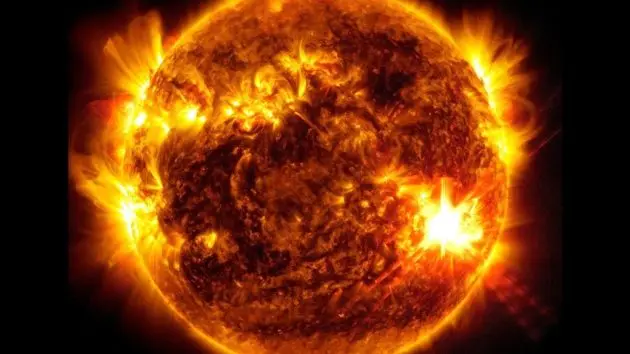
A Coronal Mass Ejection (CME) — a massive burst of solar material and magnetic field from the sun’s outer atmosphere — that occurred on Sunday is expected to reach Earth within the next 24 hours, according to the National Oceanic and Atmospheric Administration’s Space Weather Prediction Center and the U.K.’s Met Office.
Strong (G3) or severe (G4) geomagnetic storm conditions could occur as a result of the CME, including auroras that extend as far south as Alabama and northern California.
Northern light displays occur when a solar flare interacts with the atoms and molecules in Earth’s atmosphere.
As the solar flare clashes with the upper atmosphere, it causes the atoms to emit a glow, creating a spectrum of light in the night sky.
Whether the auroras will actually be visible will depend on how the CME arrives, the magnetic orientation of the CME’s magnetic field and how cloudy it is locally.
The best time to see the northern lights in the U.S. is generally between 10 p.m. and 4 a.m. local time, and traveling to the darkest location possible is recommended for the best viewing, according to NOAA.
The storm could also impact power systems, spacecraft operations, radio frequencies and satellite navigation.
Geomagnetic storms are ranked on a scale of 1 to 5. A G3 storm could require voltage corrections on power systems and cause intermittent satellite navigation and low-frequency radio navigation problems, according to NOAA.
Under a G4 storm, possible widespread voltage control problems and other issues on power grids could occur, as could increased satellite navigation and low-frequency radio navigation problems.
Spacecrafts could also experience surface charging and tracking problems.
The sun’s magnetic field reached its solar maximum phase of its 11-year cycle in October 2024 and has continued to emit strong solar flares and geomagnetic storms, leading to an increase in aurora displays.
Intense magnetic activity caused by sunspots are expected to last through 2026, according to NOAA.
NOAA is currently analyzing the data for the most recent CME.
Copyright © 2026, ABC Audio. All rights reserved.