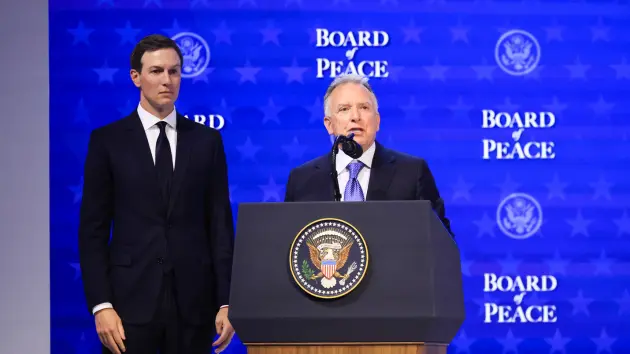
LONDON — Special envoy Steve Witkoff and Jared Kushner — U.S. President Donald Trump’s son-in-law — will lead American negotiators in Geneva, Switzerland, in high-stakes talks starting Tuesday regarding Russia’s ongoing invasion of Ukraine and the U.S. standoff with Iran over the latter’s nuclear energy program.
The talks on Ukraine will be in a trilateral format including American, Ukrainian and Russian representatives. They are the third instalment of the trilateral format following two rounds of recent negotiations in the United Arab Emirates.
Those talks were described as constructive by participants, but appeared to have failed to achieve a breakthrough on key contentious points, such as the fate of Ukraine’s partially-occupied eastern Donbas region, the future of the Russian-occupied Zaporizhzhia nuclear power plant and proposed Western security guarantees for Kyiv.
Asked what he expected ahead of talks with Russia and Ukraine in Geneva on Tuesday, Trump on Monday put the onus on Ukraine to “come to the table fast,” appearing to suggest that the U.S. and Russia “are in a position” to make a deal.
“Well they’re big talks. It’s going to be very easy,” Trump said. “Ukraine better come to the table fast. That’s all I’m telling you. We are in a position, we want them to come.”
Army Secretary Dan Driscoll and Gen. Alexus Grynkewich — the top U.S. commander in Europe and NATO’s chief military officer — will also attend the Ukraine-Russian talks in Geneva on Tuesday and Wednesday as part of the U.S. delegation, a person familiar with the upcoming discussions told ABC News.
The Ukraine talks are expected to stretch through Tuesday and into Wednesday. Ukrainian President Volodymyr Zelenskyy said in a Monday evening address that Kyiv’s negotiators had already traveled to Switzerland, warning that Moscow was preparing fresh long-range attacks on Ukrainian cities despite the ongoing diplomatic push.
Ukraine’s air force on Tuesday reported a major Russian overnight attack, in which it said Moscow launched 396 drones and 29 missiles into the country. Ukrainian forces downed or suppressed 367 drones and 25 missiles, the air force said. Four missiles and 18 drones impacted across 13 locations, the air force reported.
“It was a combined strike, deliberately calculated to cause as much damage as possible to our energy sector,” Zelenskyy wrote in a post on X. Twelve regions of Ukraine were targeted in the Russian strikes and at least nine people, including children, were injured, the Ukrainian president said.
Among the targets was the southern port city of Odesa and the wider region, where “tens of thousands of people are without heat and water supply after the drone strike,” according to Zelenskyy.
Poland’s Armed Forces Operational Command said NATO aircraft were scrambled and air defenses put on alert as a response to the Russian strikes. “No violations of the Republic of Poland’s airspace by objects that could pose a threat were recorded,” the command said on X.
Russia’s Defense Ministry, meanwhile, said its forces shot down at least 151 Ukrainian drones overnight.
Also on Tuesday, U.S. representatives are scheduled to take part in talks over Iran’s nuclear program. The talks will be mediated by Oman, traditionally a conduit for U.S.-Iran exchanges.
Iran’s Foreign Minister Abbas Araghchi arrived in Geneva on Monday. Araghchi said in a post to X that he would hold talks with International Atomic Energy Agency chief Rafael Grossi and Omani Foreign Minister Badr Albusaidi.
“I am in Geneva with real ideas to achieve a fair and equitable deal,” Araghchi wrote. “What is not on the table: submission before threats.”
Trump told reporters aboard Air Force One on Monday that he would be “indirectly” involved in Tuesday’s talks with Iran.
“They’ll be very important,” Trump told reporters of the talks. “We’ll see what can happen. Specifically, Iran is a very tough negotiator.”
Trump has said the U.S. wants Iran to end all nuclear enrichment as part of any deal, while American officials have also indicated that the U.S. wants constraints on Tehran’s ballistic missile program and its support of regional proxies.
All three demands have long been U.S. goals, but such proposals have been repeatedly rebuffed by Iranian leaders.
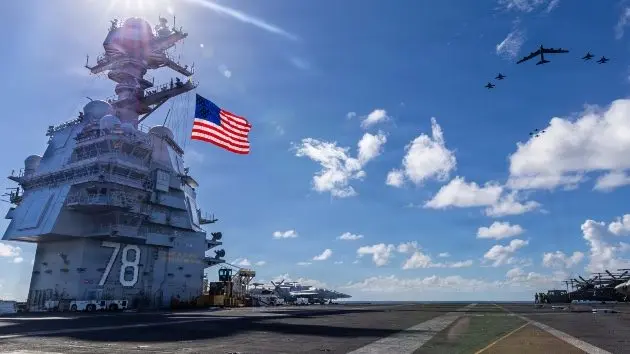
The talks have been preceded by a U.S. military buildup in the Middle East, with officials in Tehran warning that Iranian forces will retaliate against U.S. and Israeli targets if Iran is attacked.
The latest round of talks also come in the aftermath of a major anti-regime uprising in Iran, in which protests — initially sparked by the deteriorating economic conditions inside the country — spread nationwide. Trump offered his support to the demonstrators, telling them to “keep protesting”, saying “help is on its way.”
Security forces violently suppressed the demonstrations, killing at least 7,000 people according to data published by the U.S.-based Human Rights Activists News Agency (HRANA).
Copyright © 2026, ABC Audio. All rights reserved.