(VIENNA, Austria) — The International Atomic Energy Agency (IAEA) warned on Monday that the possibility of radiological release due to U.S.-Israeli strikes in Iran can’t be ruled out.
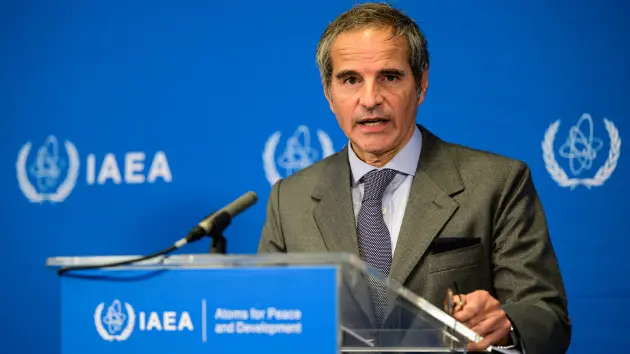
Speaking before the Board of Governors at the agency’s headquarters in Vienna, IAEA Director General Rafael Mariano Grossi said there were no signs of strikes to Iran’s nuclear facilities or elevated radiation levels above the usual background levels detected in countries bordering Iran.
Rossi said that, currently, it doesn’t appear the Bushehr Nuclear Power Plant, the Tehran Research Reactor or other nuclear fuel cycle facilities have been damaged or hit.
“The IAEA has extensive knowledge of the nature and location of nuclear and radiological material in the region, and we have clear guidance for actions necessary in case an attack or an accident causes a radiological release, as well as the ability for hands-on help if it is required,” Rossi said.
“Let me underline that the situation today is very concerning,” he continued. “We cannot rule out a possible radiological release with serious consequences, including the necessity to evacuate areas as large or larger than major cities.”
Rossi said the IAEA’s Incident and Emergency Centre (IEC) has a team in place collecting information and assessing the situation, but the conflict has made communication difficult.
The IEC said it is continuing to try and connect with Iranian nuclear regulatory authorities, but with no response so far.
“Let me again recall past General Conference resolutions that state that armed attacks on nuclear facilities should never take place and could result in radioactive releases with grave consequences within and beyond the boundaries of the State which has been attacked,” Rossi said.
He urged all parties to return to diplomacy and regulation to achieve the long-term assurance that Iran will not acquire nuclear weapons.
President Donald Trump said over the weekend that a preemptive attack on Iran was justified by “imminent threats” from the Iranian guard, though he provided no evidence, and to topple the Iranian regime.
U.S. intelligence seemed to counter the president’s claims. According to the Defense Intelligence Agency, Iran is working on developing a missile capable of reaching the U.S. by 2035.
Last year, the U.S. bombed three of Iran’s nuclear sites. Experts have said there are recent signs of Iran trying to rebuild its program and begin again enriching uranium, but that there was no evidence they were close to building a bomb.
ABC News’ Anne Flaherty contributed to this report.
Copyright © 2026, ABC Audio. All rights reserved.