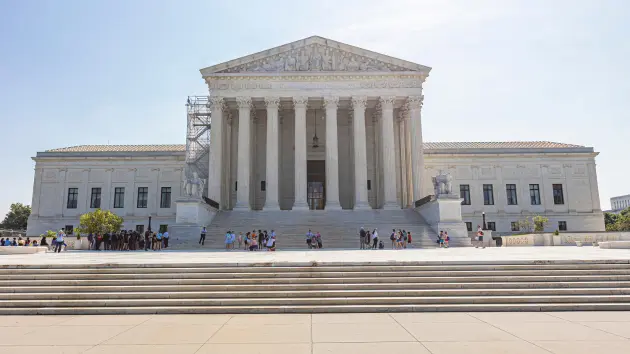
(NEW YORK) — Three years after affirming a constitutional right of Americans to carry a gun for self-defense, the U.S. Supreme Court on Tuesday will consider whether states can limit the carry of firearms on private property open to the public without first receiving the property owner’s consent.
The case involves a Hawaiian law and similar measures in four other states –- California, Maryland, New York and New Jersey –- where lawmakers set a strict “default rule” prohibiting the possession of handguns in privately-owned places where other members of the public might congregate, unless the owner affirmatively gives permission.
The laws govern locations such as stores, shopping malls, bars, restaurants, theaters, arenas, farms, and private beaches. It does not involve public property, which is subject to different rules.
“This law is extremely restrictive. It bans public carry in 96.4% of the publicly available land in the County of Maui,” said Alan Beck, an attorney for three Maui residents and members of the Hawaii Firearms Coalition who are challenging the law.
“They’d like to carry dropping off money at the ATM late at night or just going to have lunch at a restaurant,” Beck said. “They are unable to carry in any private business that is open to the public that is unwilling to put up a sign saying ‘guns allowed.'”
While property owners have the inherent right to exclude guns from their premises, Beck says the onus should be on them to make their wishes clear, otherwise expect that members of the public can freely exercise their Second Amendment rights as a matter of standard practice.
Unlike Hawaii, 45 states permit licensed handgun owners to presume they can legally carry their weapons onto private property open to the public, unless the owner explicitly bans guns by issuing verbal instructions or posting a sign.
“The express purpose of this law is to make it so that less people exercise their constitutional rights,” Beck said.
Hawaii officials argue in court documents that never in the nation’s history has there been a “right to armed entry onto private property without consent” and that its law is meant to protect a property-owner’s right to exclude guns without having to take extra steps.
“The basic principle is that private property owners are empowered to set the rules for their property, and the state can make it easier for private property owners to do so,” said Douglas Letter, chief legal officer at Brady, a gun safety group.
“Hawaii’s law is obviously eminently reasonable,” Letter added. “Visitors simply must get a private property owner’s permission to bring a firearm onto that property.”
The Supreme Court will evaluate the Hawaii law using a test laid out in a landmark 2022 decision in which Justice Clarence Thomas, writing for the conservative majority, said only gun regulations consistent with “the Nation’s historical tradition of firearm regulation” can stand.
Hawaii points to an 1865 Louisiana law and 1771 New Jersey law as imposing nearly identical property restrictions as its current measure. The plaintiffs say they are “outlier” examples and not the historic norm. The Ninth Circuit U.S. Court of Appeals upheld Hawaii’s law, holding that “a national tradition likely exists of prohibiting the carrying of firearms on private property without the owner’s oral or written consent.”
Beck and co-counsel Kevin O’Grady said they expect the justices will likely reverse that ruling in their favor. “Just because Hawaii is giving lip service to the Second Amendment when they’re doing the kind of things they’re doing — and doing these mental gymnastics to try to justify this law,” O’Grady said, “it will not be tolerated by the U.S. Supreme Court.”
A decision in the case is expected by the end of June.
Copyright © 2026, ABC Audio. All rights reserved.